Skip to the offer

Instant download · One-time $37 · 72-page PDF + 7 printable checklists

Outboard Tips Practical Outboard Maintenance
34 years fixing outboards

Know what to check before a small outboard problem becomes an expensive repair.

The practical owner's guide to the warning signs, maintenance checks and bad habits I saw turn into expensive failures during 34 years behind the service counter.

Get the Guide — $37
  • Instant download
  • One-time payment
  • Works on your phone

“The worst repair bills I ever wrote had one thing in common. The engine had been warning the owner for weeks.”

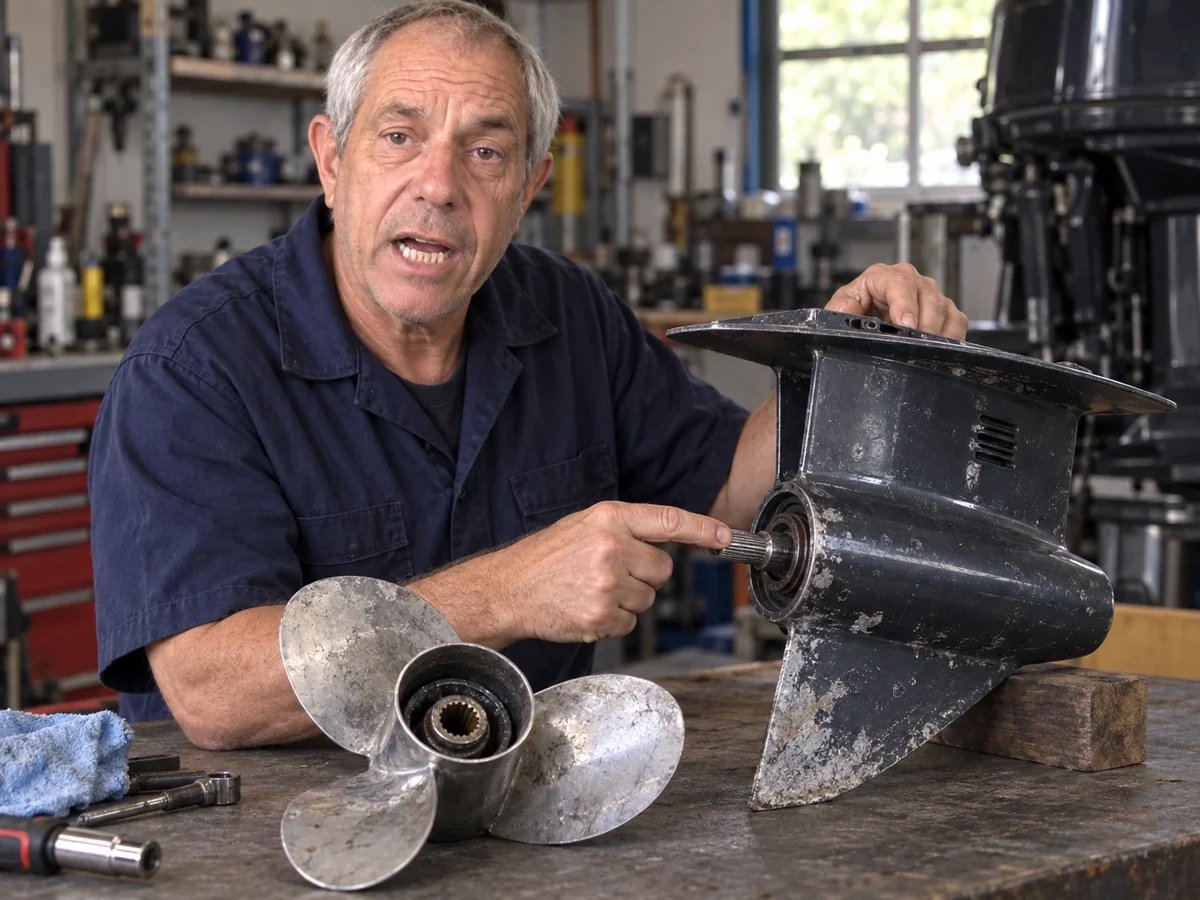
Mike in his workshop pointing at the prop shaft on a lower unit, with a removed propeller on the bench in front of him
The cover of The Outboard Owner's Survival Guide
$37One-time
Mike, retired factory-certified outboard technician Mike 34 years · Yamaha & Mercury

The pattern

The expensive repair usually doesn’t start the day the engine fails.

A powerhead that lets go in July usually started down that road back in April. The engine was saying so the whole time — and the owner was the only person in a position to hear it.

Not every failure can be prevented. Some parts just let go. But the repairs that hurt the most were rarely the surprises. They were the slow ones.

Mike at his workbench in the shop, an outboard powerhead on a stand beside him and the marina visible through the open roller door
34 years of engines arriving after the cheap fix had already passed.

The warnings owners tell me about afterwards

  • A sound that changed and then became normal
  • A vibration that showed up after a shallow run
  • Gear oil that came out a little gray at the last service
  • A telltale that got lazy over a couple of seasons
  • A chipped propeller blade nobody got around to fixing
  • Harder starting every spring, blamed on the weather
  • White powder around the fasteners
  • An alarm that sounded once and then stopped

Every one of those is cheap to deal with on the day you notice it.

How a $40 problem turns into a four-figure one

  1. 1

    A small warning

    Something changes. A noise, a vibration, a weaker telltale, oil that looks off.

  2. 2

    It gets ignored

    The engine still runs, so it goes on the list for sometime. You get used to it.

  3. 3

    Damage spreads

    Water keeps getting in. Heat keeps building. The vibration keeps loading the bearings.

  4. 4

    The big repair bill

    Now it isn’t a seal or an impeller. It’s a gearcase, or a powerhead, and a lost season.

The guide is built around interrupting that sequence at stage one — which is the only stage where it is cheap.

What it costs to wait

One missed warning sign can cost more than this guide many times over.

Here is the same problem — a few wraps of fishing line behind the prop — priced at four different moments. Nothing about the fault changes. Only when somebody noticed it.

  1. Stage 1

    Caught on the day

    You spot fishing line wrapped behind the propeller and pull it off.

    Ten seconds. No parts.
  2. Stage 2

    Caught early

    The seal is weeping, but no water has got inside yet. A shop replaces it.

    A modest labor job.
  3. Stage 3

    Caught late

    Gear oil comes out milky. The case has to come apart and be cleaned out.

    Parts plus real labor.
  4. Stage 4

    Caught at the noise

    Gears, bearings and shafts — or a replacement gearcase, which is often the economic answer.

    The four-figure conversation.

Put $37 next to the alternatives

One diagnostic visit at a shop can cost more than this guide. So can one tow back to the ramp, one lost weekend, or one gear oil change where nobody looked at what came out.

I am not going to tell you this guide prevents repairs — it doesn’t, and anyone who says otherwise is selling you something. If it helps you notice one developing problem earlier, it has done its job.

The whole guide

$37

once, not per year

Get the Guide — $37

Instant digital access

The guide

I put 34 years of shop experience into one owner’s field guide.

72 pages. Eighteen sections. Checklists you print and keep with the boat, symptom charts you open when something changes, and log pages that turn into a real service record. Set up so you never have to read it cover to cover.

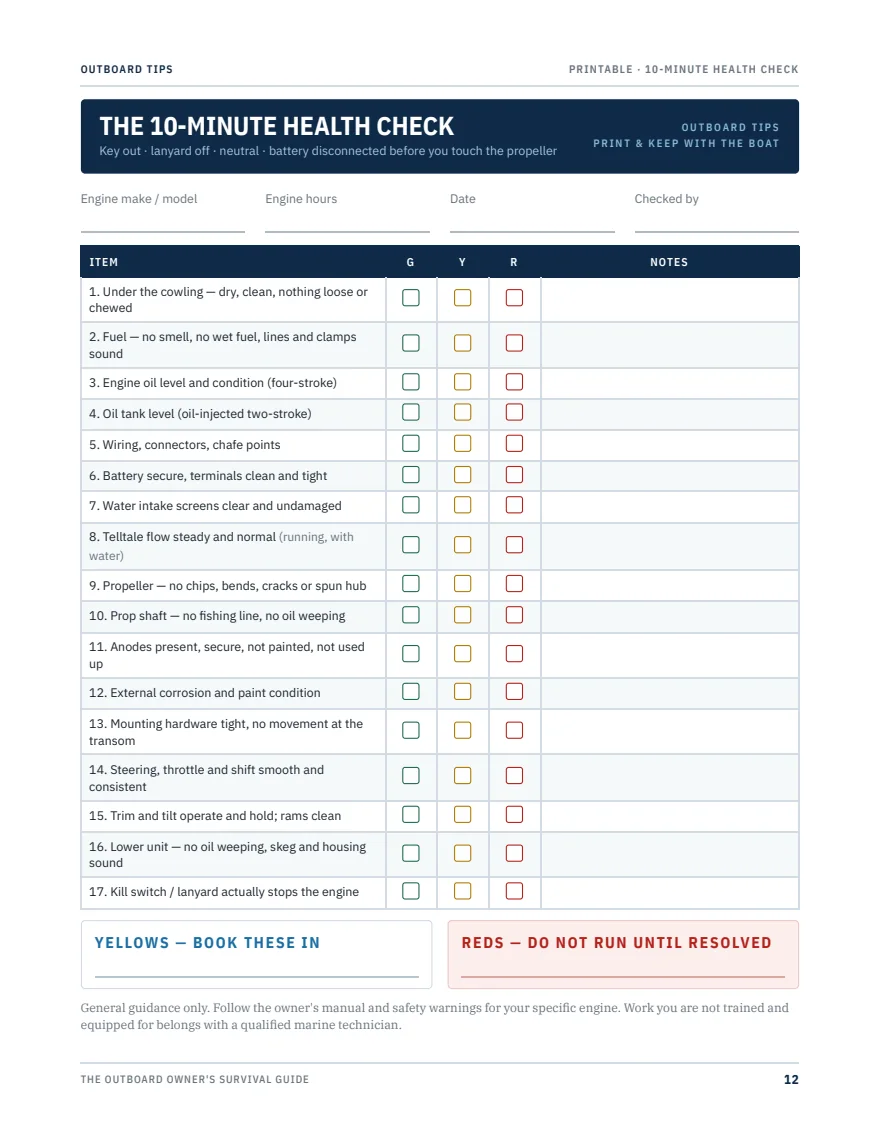
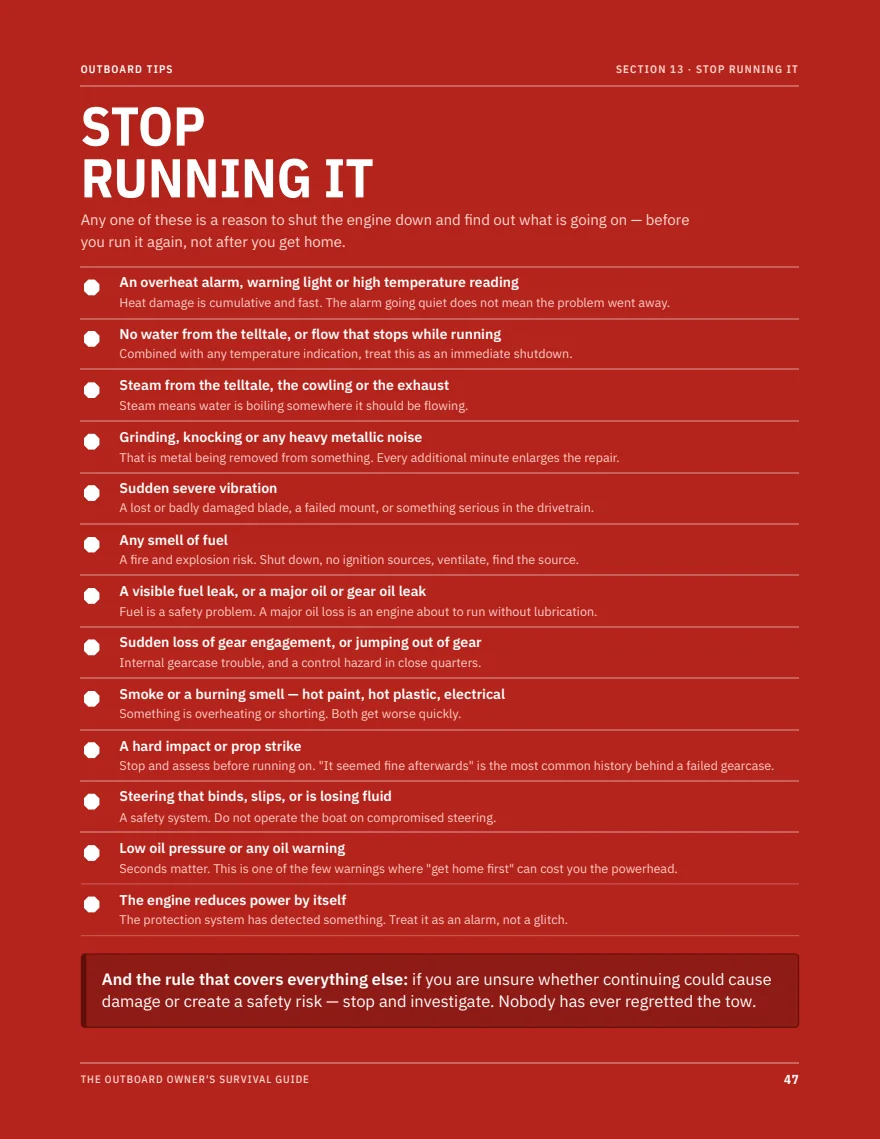
A printable page from the guide: the 10-Minute Health Check, seventeen items rated green, yellow or red A page from the guide: the red Stop Running It page listing thirteen conditions that justify shutting the engine down The cover of The Outboard Owner's Survival Guide
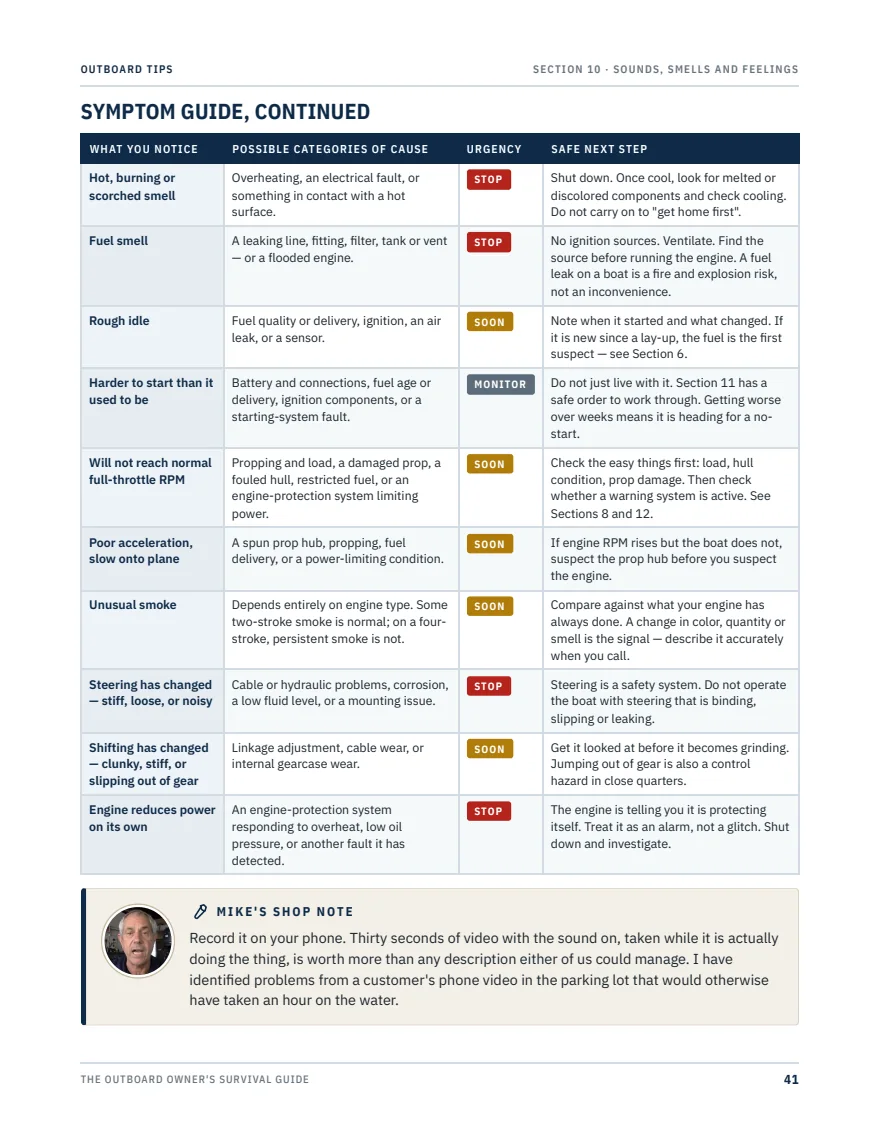
The guide open on a tablet showing the symptom troubleshooting chart: what you notice, possible causes, urgency, and the safe next step
  • Reads fine on a phone at the dock — no app, no login

  • Prints clean on ordinary US Letter paper

  • Every checklist is also a separate one-page PDF

  • Yours to keep, re-print and mark up as often as you like

What you get

Everything inside the guide.

Eighteen sections. The ones marked Printable are designed to stand alone — print them, put them in a clear sleeve, and leave them with the boat.

  • 01Printable

    The 10-Minute Outboard Health Check

    Seventeen items, each rated green, yellow or red so you know what needs attention and what can wait.

  • 02Printable

    Before-every-trip checklist

    A three-minute walk-around in the same order every time. The order is what stops you skipping things.

  • 03Printable

    After-every-trip checklist

    The ten minutes at the end of the day that save engines — separate steps for salt and fresh water.

  • 04Worksheet

    100-hour / annual maintenance planner

    A framework, not a schedule. You fill the intervals in from the manual for your exact engine.

  • 05

    Lower-unit & gear-oil warning guide

    How to read the oil that comes out: clean, milky, gray, metal. What each one suggests and what to do.

  • 06

    Cooling-system warning signs

    What the telltale does and doesn’t prove, normal versus concerning behavior, and when to shut down.

  • 07

    Fuel & storage guide

    Aging fuel, ethanol, water and phase separation — plus a decision chart for an engine that has been sitting.

  • 08

    Propeller & prop-shaft inspection

    What different damage tells you, and the five things to check any time the prop is off the shaft.

  • 09Printable

    Corrosion & saltwater checklist

    Anodes, the places corrosion actually starts, and a per-trip / per-season routine you can print.

  • 10

    Symptom troubleshooting charts

    Noises, smells, vibration, hard starting, running badly, won’t start. Cause categories, urgency, safe next step.

  • 11Print it

    The “Stop Running the Engine” page

    Thirteen conditions that justify shutting down and investigating. Designed to be readable in ten seconds.

  • 12Printable

    Used outboard quick inspection

    Twenty-eight points to work through before you hand over money, including what to ask before you drive out.

  • 13

    Repair-shop question checklist

    The ten questions to ask before approving a big repair — from someone who spent 34 years on the other side of that counter.

  • 14Printable

    Maintenance, fuel, problem & repair logs

    Printable record pages. The cheapest diagnostic tool there is, and worth real money when you sell the engine.

  • Bonus

    The $4,000 Repair Prevention Checklist

    The nine systems that actually produce four-figure invoices, and the one red flag on each that means act now.

    Named after the kind of major lower-unit repair owners most want to catch early — not a promise about what you’ll save.

Get the Guide — $37

Instant digital access • One-time payment

Look inside

This isn’t a 72-page book you’ll read once and forget.

It’s designed to be opened when you need to check something. These are real pages, exactly as they print.

  • The 10-Minute Health CheckSeventeen items, rated as you go. Print it, tick it, keep it.
  • Stop Running ItThirteen conditions, in red, readable from the helm in seconds.
  • Reading the gear oilWhat comes out of the gearcase, what it means, what to do.
  • Lower unit, explainedDrawn for this guide — and captioned as generic, because layouts vary.
  • Used outboard inspection28 points. Take it with you before you hand over money.
  • The prevention sweepFrom the bonus section. Twice a season, manual open beside you.
Get All 72 Pages — $37

Instant digital access • One-time payment

Who it’s for

This guide is for you if…

  • You own an outboard, but you’re not a mechanic.

  • You want to understand what your engine is telling you.

  • You’d rather not be surprised by a repair bill.

  • You boat in salt water and want to stay ahead of corrosion.

  • You bought a used engine and want to protect it.

  • You want to know what to check before you call the shop.

  • You want this engine to last as long as you own the boat.

Being straight with you

What this guide is not.

I’d rather you skip this than buy it expecting something it isn’t.

  • A factory service manual

    No torque specs, no exploded diagrams, no rebuild procedures.

  • A replacement for your owner’s manual

    The opposite — it sends you to your manual on almost every page, because intervals and specs differ by engine.

  • A rebuild manual

    Nothing here teaches you to split a powerhead or open a gearcase.

  • A promise that nothing will ever fail

    Some parts just let go. This is about the failures that give you warning first — which is most of the expensive ones.

Mike standing in his shop with his arm resting on the cowling of an outboard, rows of engines and tools behind him

Mike

Factory-certified outboard technician (retired)
Sarasota, Florida · 34 years

Who’s telling you this

I spent 34 years seeing what happens after owners miss the warning signs.

I didn’t learn this from reading about outboards online. I learned it by pulling apart engines that had already failed.

I’m 67. I started turning wrenches on outboards in my early thirties and stopped when my shoulders told me to. Most of that time was Yamaha and Mercury, with several years on Honda Marine product as well.

  • Factory-certified technician — I held the certifications and went to the schools.
  • Routine servicing, and a lot of it — the boring work that keeps engines alive.
  • The diagnostic jobs other shops had already given up on.
  • Failed lower units, torn down to find where the water got in.
  • Powerhead rebuilds, back when rebuilding still made financial sense.
  • Manufacturer warranty reports — what failed, why, and who is responsible.

That last one changed how I look at engines. A warranty report isn’t a guess — you have to show your work. You read the wear patterns, the heat marks and the scoring, and you write down what the evidence says.

Do that a few hundred times and you stop seeing accidents. You start seeing the same short list of preventable things, over and over, on every brand. This guide is that list.

I don’t sell engines and I don’t sell parts, so I have no dog in the brand fight. The engines that lasted weren’t the ones with the right badge on the cowling. They were the ones whose owners flushed them, changed the fluids, and paid attention when something changed.

Fair questions

Three things owners say before they buy this.

Mike gesturing as he explains a point Mike answers

“I already have an owner’s manual.”

Your owner’s manual tells you what to service. This guide helps you know what to notice.

They do different jobs. Your manual is model-specific: procedures, capacities, intervals, specifications for your exact engine. It is the authority on all of that, and nothing here replaces it.

What a manual generally doesn’t give you is the owner-level layer — what a healthy engine looks and sounds like, which changes matter, what drained gear oil is telling you, which habits quietly shorten engine life, and when to stop and call somebody.

The guide sends you back to your own manual constantly. There’s an “Owner’s Manual Check” callout on page after page, and the maintenance planner ships with the interval column blank on purpose — you fill it in from your engine’s manual, and then you have a plan that’s actually correct for your engine.

Short version: the manual tells you what to do. This tells you what to look at, and when it matters.

Mike, listening Mike answers

“I’m not mechanical.”

You don’t need to rebuild an engine. You need to know when something has changed.

Almost everything in this guide is done with the engine off, the key out and your hands nowhere near the propeller. It’s looking, listening, smelling, touching, and writing things down.

There is a whole page early on that draws the line between what an owner can reasonably check and what belongs with a qualified technician — and the guide stays on the owner’s side of that line the whole way through.

If you can tell that a noise is new, you already have the skill this guide is built on. The rest is knowing where to look and what it’s worth telling somebody about.

Mike making a point Mike answers

“I just let my mechanic handle it.”

A mechanic can fix your engine. They can’t watch it between service visits.

Good. Keep using them — I spent 34 years being one. But your mechanic sees the engine once or twice a year. You’re the one who’s there when the vibration starts, when the alarm sounds, when the telltale changes, when it gets harder to start.

The single most useful thing an owner ever told me wasn’t “it’s making a noise.” It was “it started three weeks ago, right after we ran through the shallows, and it’s got worse since.”

That sentence turns a two-hour diagnostic into a twenty-minute one, and you pay for the difference either way. This guide teaches you to be able to say it.

Get the Guide — $37

Instant digital access • One-time payment

Where this comes from

No star ratings. Just what the guide is built on.

This is a new product and I’m not going to dress it up with testimonials it hasn’t earned yet, or a review score I’ve invented. Judge it on the pages you can see above and on where the material came from.

Mike seated at his workbench with an old service logbook and his reading glasses in front of him
Thirty-four years of other people’s service records. The patterns in this guide came out of books like that one.
Mike, retired factory-certified outboard technician

“If it’s not true, it doesn’t go in. That applies to the guide and it applies to this page.” — Mike

  • 34years

    Full-time outboard repair

    Not a hobby, not a side interest. A career spent on engines that had already failed.

  • 4brands

    Hands-on experience

    Yamaha and Mercury mainly, several years of Honda Marine, and the general principles apply across Suzuki and others.

  • 72pages

    You can see before you buy

    Real pages are shown above, not stock mockups. What you see is what prints.

  • 0invented specs

    Everything defers to your manual

    No made-up intervals, torque values or capacities. Where a number would be engine-specific, the guide says so and sends you to your manual.

The offer

Everything you get for $37.

The Outboard Owner’s Survival Guide

A 72-page owner’s field manual, plus seven standalone printable checklists

  • The complete 72-page digital guide18 sections, print-ready US Letter PDF, reads fine on a phone
  • The 10-Minute Outboard Health Check17 items, each rated green / yellow / red — printable
  • Before-every-trip checklistA three-minute walk-around you can keep with the boat
  • After-every-trip checklistThe ten minutes at the end of the day that actually matter
  • 100-hour / annual maintenance plannerYou fill the intervals in from your own engine’s manual
  • Used-outboard inspection checklist28 points to work through before you hand over money
  • Symptom troubleshooting chartsNoises, smells, hard starting, running badly, won’t start
  • Maintenance, fuel, problem and repair logsPrintable record pages — the cheapest diagnostic tool there is
  • Bonus: The $4,000 Repair Prevention ChecklistThe nine systems that produce the big invoices, and the red flag on each

One-time payment

$37

No subscription. No upsell. Yours to keep and re-print.

Get the Complete Guide — $37

Instant digital access • One-time payment

Why not leave it until the spring?

  • The best time to notice a developing problem is before your next trip, not after the tow back to the ramp.
  • Small warning signs rarely get cheaper when they’re ignored.
  • Your next service interval is easier to plan before you’re dealing with a breakdown.

No countdown timers on this page, and no fake stock levels — it’s a PDF, there are infinite copies. The only thing running out is the time before your next trip.

Questions

Before you buy.

Is this guide only for Yamaha owners?

No. It’s built around owner-level principles that apply across brands — cooling, gear oil, fuel, corrosion, propellers, warning signs — with constant reminders to follow the manual for your exact engine wherever a number or a procedure is involved.

Does it cover Mercury?

Yes, at a general owner level. Mercury and Yamaha are the two brands I worked on most, and nothing in the guide is written to favour either one.

What about Honda and Suzuki?

Yes, where the principles are broadly applicable — which is most of the guide. I spent several years on Honda Marine product. The specifics for any engine still come from that engine’s manual.

Is this a repair manual?

No. There are no rebuild procedures, no torque figures and no exploded diagrams. It’s about recognising problems early and knowing what to do next — including when the answer is “stop and call somebody.”

Do I need mechanical experience?

No. It’s written for owners, not mechanics. Nearly everything is done with the engine off and the key out, and there’s a page early on drawing the line between owner checks and technician work.

Can this replace my factory manual?

No, and it says so repeatedly. Your manual is the authority on intervals, capacities, fluids and procedures for your engine. This guide sits alongside it — the maintenance planner literally has a blank column for you to copy your manual’s intervals into.

Is this a physical book?

No — it’s a digital download. You get the full 72-page PDF plus seven separate one-page checklist PDFs, so you can print just the page you need.

Can I use it on my phone?

Yes. It’s a standard PDF, so it opens on a phone, a tablet or a computer with no app and no login. Plenty of owners will keep it on their phone and print only the two trip checklists.

Does it tell me exactly when to service my engine?

It gives you the planning tools — a maintenance planner, logs and a seasonal framework — but the manufacturer’s schedule for your exact engine controls. I deliberately print no intervals of my own, because they genuinely differ by brand, model, year and how you use the boat.

How do I get it after paying?

Instant digital access — the download is delivered as soon as the payment goes through, and the files are yours to keep.
Get the Guide — $37

Instant digital access • One-time payment

Last thing

The cheapest repair is the one you catch before it becomes a big repair.

After 34 years in the shop, that’s the lesson I wish more owners understood. The expensive ones were almost never sudden. They were slow, they gave signs, and somebody could have caught them for the price of ten minutes and a bit of attention.

The reason nobody did wasn’t carelessness. It was simply not knowing which small things were worth looking at.

Get the Complete Guide — $37
  • Instant download
  • One-time $37
  • 72-page PDF + 7 printables
Mike, retired factory-certified outboard technician, Sarasota, Florida — Mike Outboard Tips · Sarasota, Florida
Mike standing on a dock in the Florida sun beside a center console boat with a large outboard, a notebook under his arm
Sarasota, Florida. Still looking at other people’s engines.